Patients on GLP-1 medications often reach their goal weight within a year, with improved energy, better bloodwork, and visible physical change. But alongside these welcome results, a less discussed set of changes tends to appear, ones that affect the skin, the face, and the body’s overall contour.
These are the five effects that most GLP-1 patients are not prepared for, and that rarely come up in the prescribing conversation.
1. The face may age before the body catches up
The term “Ozempic face” emerged from patient experience, not from clinical research. People who lost 40 or 50 pounds began noticing that their face looked older, even while their body looked better.
The reason is anatomical. The face has distinct fat compartments, small pockets of fat in the cheeks, around the eyes, and along the jawline, that give it shape and fullness. Far from being “extra,” these fat pads are structural components that keep the face looking smooth, rested, and full of life.
When GLP-1 medications like semaglutide (Ozempic, Wegovy) or tirzepatide (Mounjaro, Zepbound) reduce body fat, they also reduce these facial fat pads. The skin over them loses its support and begins to drape differently, hollowing the cheeks, deepening nasolabial folds, and making the bone structure underneath more prominent.
A woman who expected to look ten years younger after dropping three dress sizes might find that her face tells a different story. That disconnect between expectation and reality is one of the most common unspoken frustrations among GLP-1 patients.
2. How the “deflation” effect differs from sagging
Most people assume that loose skin after weight loss is about gravity pulling things down. Traditional sagging happens when weakened collagen and elastin can no longer hold the skin’s weight against gravity, causing it to droop. The effect that follows GLP-1 weight loss is different, and understanding the distinction changes how patients think about solutions.
What happens during rapid GLP-1 weight loss is closer to deflation. The subcutaneous fat layer (the fat just beneath the skin) acts like a cushion between the skin surface and the muscle below. When that cushion shrinks rapidly, the skin above it no longer has anything filling it out from underneath. The skin looks emptied, like a pillow that lost half its stuffing, rather than dragged downward by its own weight.
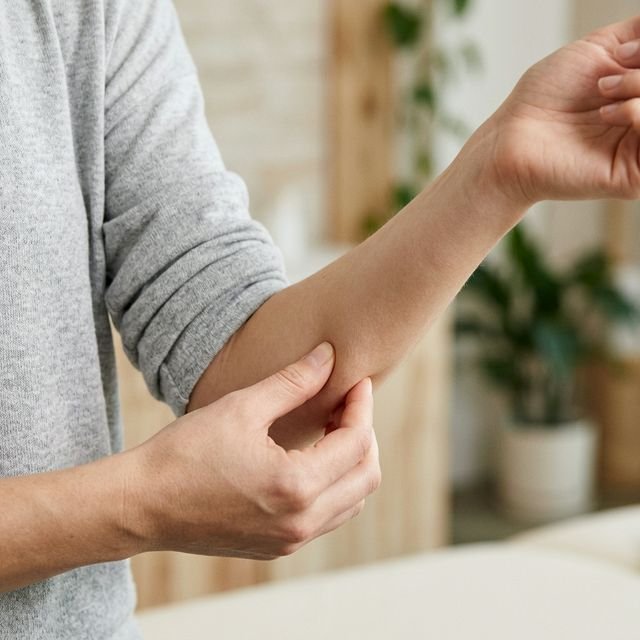
This happens on the face, but also on the upper arms, the abdomen, the inner thighs, and the chest. Clinical data show that in patients who lose significant weight after bariatric surgery, over 90% develop excess skin. The difference with GLP-1 medications is the number of people affected: an estimated 6 million Americans were on GLP-1 treatment by 2024, with projections reaching 10 million in 2025.
The deflation effect is a predictable physical outcome of removing volume from under the skin faster than the skin can adapt.
3. Skin is on a completely different clock than the scale
GLP-1 medications are effective precisely because they produce significant weight loss in a short timeframe. In the STEP clinical trials, patients on semaglutide lost an average of 15% to 17% of body weight over 68 weeks. Tirzepatide, in the SURMOUNT trials, produced even larger losses of 16% to 22.5%.
The speed of pharmaceutical fat loss far outpaces the skin’s biological capacity to contract. Skin’s firmness depends on two proteins: collagen (which provides structure) and elastin (which provides bounce). Both proteins weaken with age. After 40, collagen production declines and the remaining elastin becomes less springy, which means the skin cannot tighten fast enough to match the new, smaller body.
Younger patients with healthy collagen reserves may handle moderate weight loss without visible skin laxity. But for patients over 40 who lose 50 or more pounds on GLP-1 medication, the gap between the body’s new size and the skin’s response time creates a visible mismatch that can take months or years to resolve on its own, if it resolves at all.
4. The window for skin tightening after weight loss is smaller than expected
Most patients only begin thinking about skin when the skin laxity is already visible. That instinct makes sense, because problems usually get addressed after they appear. But with skin laxity, the biology works differently.
Collagen production responds to stimulation. Energy-based treatments, including radiofrequency (RF), microneedling, and low-level laser therapy, trigger neocollagenesis (the body’s process of building fresh collagen) in the deeper layers of the skin. Over consecutive sessions, this new collagen gradually strengthens and tightens the skin from within.
Starting this collagen-rebuilding process early, ideally within the first few months of GLP-1 treatment, means the skin is producing new structural protein while the fat underneath is still leaving. The two processes run in parallel: the body gets smaller and the skin gradually tightens to match.
Waiting until the weight loss is complete and skin laxity is fully established means the collagen remodeling must close a gap that has been accumulating for months. The treatments still work, but the starting point is worse, and the distance to travel is greater. Think of it as the difference between keeping pace with a moving target and trying to catch up after it has already stopped.
5. Skin needs its own recovery plan
The prescribing conversation for GLP-1 medications focuses on metabolic health, not skin quality. But skin that is losing its underlying volume benefits from a dedicated, parallel protocol.
Start collagen-stimulating treatments early. A consistent protocol using energy-based devices (RF, microneedling, or low-level laser), started within the first month or two of GLP-1 therapy, gives the dermis (the deeper layer of the skin) a head start on collagen production before significant volume loss has occurred. The ideal moment to begin is when the scale starts moving, before the skin changes become visible.
Stay consistent through the active weight loss phase. Regularity matters more than intensity. Treatments two to three times per week, maintained across the full duration of active weight loss, create cumulative collagen remodeling that tracks with the body’s changing shape.
Support from the surface. Retinol and vitamin C support the skin’s ability to build collagen. They cannot replace energy-based treatments for existing skin laxity, but they supply the raw materials the skin needs during the rebuilding process.
Protect the collagen being built. Daily sunscreen prevents UV damage to newly produced collagen. During an active skin-tightening protocol, sun protection is not optional. There is no point rebuilding a foundation while allowing the elements to erode what has already been laid down.
Continue after weight stabilizes. Once the scale levels off, maintenance treatments help the skin consolidate its gains and settle into the body’s new contour.
The gap in the prescription conversation
The reason these five realities are rarely discussed is simple: GLP-1 medications were developed as metabolic treatments, and the prescribing conversation focuses on weight, blood sugar, and cardiovascular health. Skin quality is not part of the clinical endpoint.
But the experience of living in a body whose surface has not caught up with its interior is real, it is common, and it is not something patients should need to figure out alone.