Most skincare routines are built around products: cleansers, serums, moisturizers, sunscreens. Each one targets the skin’s surface or the layers just beneath it. And for surface-level concerns (hydration, texture, mild discoloration), products work well.
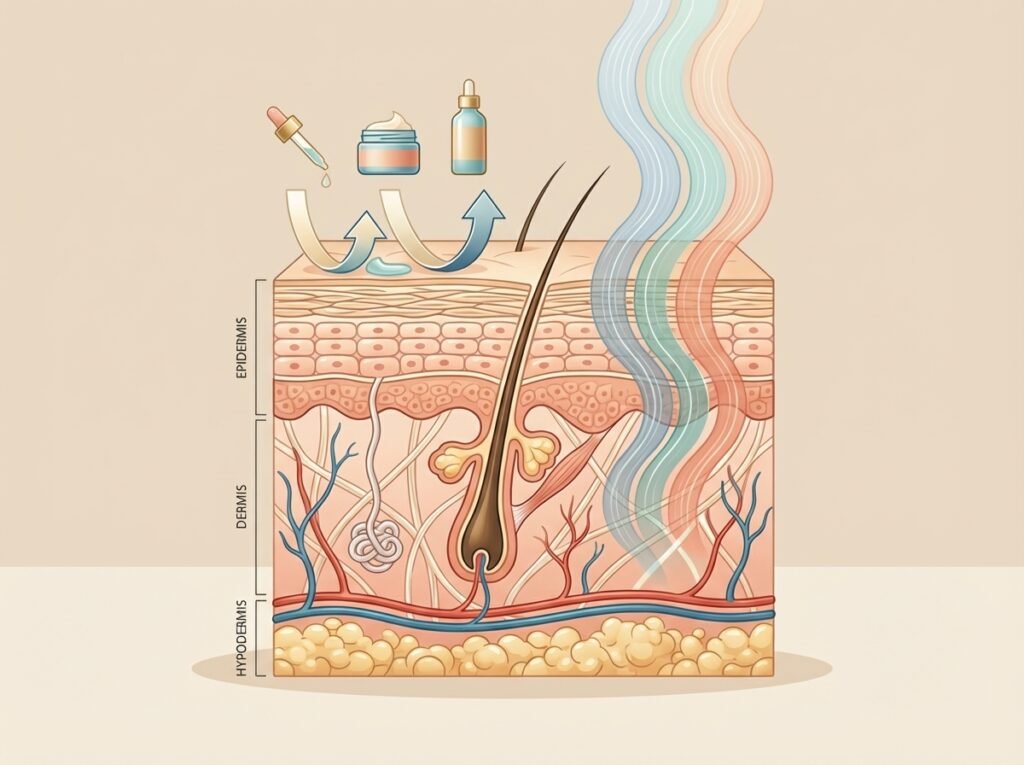
But the structural layer of skin that determines firmness, elasticity, and wrinkle resistance sits deeper, in the dermis, 2 to 4 millimeters below the surface. Reaching that layer with a product alone is where the biology imposes a hard limit.
The barrier that products cannot cross
The stratum corneum, the outermost sublayer of the epidermis, exists to keep things out. This is useful for defending against pathogens and environmental stressors. It is less useful when the objective is to deliver active ingredients to the dermis.
The 500 Dalton rule (Bos and Meinardi, 2000) established that molecules above 500 Da (Daltons, a unit of molecular weight) are unlikely to penetrate intact skin. Many clinically relevant active ingredients sit near or above this threshold. Even for smaller molecules that cross the barrier, the concentration reaching the deep dermis is a fraction of the applied surface dose.
This creates a core limitation: the tissue layer most responsible for visible aging is the layer least accessible to the products designed to treat it. A high-quality retinol serum can stimulate the upper dermis effectively. It cannot reach the deep dermis where the structural collagen and elastin reside, at least not in concentrations sufficient to produce significant structural change.
How energy-based treatments reach deeper tissue
Energy-based treatment devices bypass the epidermal barrier entirely.
Radiofrequency (RF) generates heat through tissue impedance. Multi-polar electrode configurations deliver thermal energy to the dermis at 2 to 4 millimeters depth, heating collagen to the 40 to 45 degree Celsius range that triggers neocollagenesis (the body’s process of building fresh collagen). The energy passes through the epidermis without being limited by stratum corneum permeability.
Microneedling creates controlled micro-channels through the stratum corneum, physically bypassing the permeability barrier and triggering a wound-healing cascade that activates fibroblast collagen production.
LED photobiomodulation delivers specific light wavelengths (630 to 850 nm) that penetrate to dermal depth and are absorbed by cytochrome c oxidase in mitochondria, boosting cellular ATP production and activating repair-associated transcription factors.
Each modality reaches tissue that topicals alone cannot effectively access. But none of these modalities addresses the epidermal and upper-dermal processes (cell turnover, surface hydration, antioxidant protection) that topical products handle well. The two categories treat different tissue depths. An effective skincare protocol covers the full architecture by combining both.
The permeability window: where the synergy happens
Beyond simple depth complementarity, a specific synergistic mechanism makes a combined skincare protocol measurably more effective than using devices and products separately.
Controlled thermal delivery to the epidermis temporarily disrupts the lipid organization of the stratum corneum. This disruption increases intercellular spacing and transiently reduces barrier function for approximately 20 to 60 minutes after treatment.
During this permeability window, topical active ingredients penetrate more effectively. Studies have documented 2x to 5x increases in penetration depth for hydrophilic molecules applied during the post-treatment window. The energy-based treatment effectively opens a temporary pathway through which products can reach deeper tissue than they could on intact skin.
This mechanism is well-established in professional aesthetics. Post-treatment product application is standard skincare protocol in clinical settings. The clinician performs the energy-based treatment, then applies concentrated actives while the barrier is temporarily more permeable.
Consumer protocols that replicate this sequencing (device treatment first, actives applied during the permeability window) access the same biological mechanism. The timing and order matter: applying thick occlusive products before device use can interfere with energy transmission, and waiting too long after device use misses the permeability window.
Overlapping biological cascades
The combination produces another layer of synergy through overlapping biological cascades that amplify collagen production beyond what either approach achieves alone.
RF-induced neocollagenesis activates fibroblasts through the wound-healing cascade: the thermal stimulus signals deep dermal fibroblasts to produce collagen. Topical retinoids simultaneously activate fibroblasts through a different pathway: retinoid receptor (RAR/RXR) binding. The fibroblast receives two collagen-production signals through two independent pathways, producing a stronger aggregate response than either signal generates on its own.
Ascorbic acid (vitamin C), applied topically during the permeability window, provides the enzymatic cofactor required for proper collagen cross-linking. Newly synthesized collagen without adequate vitamin C availability has reduced structural integrity. Topical vitamin C ensures that the collagen being produced in response to energy-based stimulation is properly formed.
Sunscreen prevents UV-driven matrix metalloproteinase (MMP) activation, the primary external mechanism of collagen degradation. A collagen-building protocol without photoprotection is building and demolishing simultaneously.
The clinical data behind each modality
The evidence for individual modalities helps explain why combining them produces a stronger cumulative result.
Radiofrequency has been studied extensively for non-invasive skin tightening. Controlled thermal injury to the dermis triggers a wound-healing cascade that produces measurable neocollagenesis over 60 to 90 days per treatment cycle. Histological studies show increased Type I and Type III collagen density in the dermis following consistent RF protocols, with clinical improvement in laxity and fine lines continuing for several months after the final session.
LED photobiomodulation was evaluated in a prospective, randomized, placebo-controlled, double-blinded, split-face clinical study by Lee et al., which treated 76 patients with 830 nm and 633 nm LED wavelengths twice weekly for four weeks. The treated side showed a 36 percent reduction in wrinkles and a 19 percent increase in skin elasticity compared to baseline. Histological examination confirmed a marked increase in both collagen and elastic fibers, with ultrastructural imaging showing highly activated fibroblasts surrounded by abundant new structural protein.
Microneedling serves a dual function in a skincare protocol. It triggers neocollagenesis through controlled micro-injury (the same wound-healing cascade as RF, accessed through mechanical rather than thermal stimulation), and it simultaneously creates micro-channels through the stratum corneum that act as a transdermal delivery system, facilitating the penetration of active ingredients to deeper layers of skin. Clinical studies using microneedling followed by topical vitamin C or tranexamic acid have demonstrated measurable improvement in skin quality that exceeds what either intervention achieves on its own.
Choosing modalities for a skincare protocol
Each energy-based modality accesses slightly different tissue depths and biological pathways, which means they are complementary rather than interchangeable.
RF delivers thermal energy to the deep dermis (2 to 4 mm), primarily triggering collagen contraction and neocollagenesis. It is most effective for laxity and structural firmness.
LED works at the cellular level across a broader tissue range, stimulating mitochondrial activity and fibroblast activation without thermal injury. It is well-suited for maintenance, recovery between more intensive treatments, and cumulative collagen support over long treatment periods.
Microneedling accesses the upper and mid-dermis through mechanical channels, making it particularly effective as a delivery vehicle for topical actives while simultaneously triggering its own collagen response. It pairs naturally with concentrated serums applied immediately after treatment.
A comprehensive skincare protocol may incorporate more than one energy-based modality alongside topical actives, using each for its specific strengths: RF for deep structural remodeling, microneedling for enhanced ingredient delivery, and LED for ongoing cellular stimulation. The topical layer (retinoids, vitamin C, peptides, sunscreen) runs across all of them, supporting the biological processes that each device initiates.
The evidence-based skincare protocol
Clinical skincare protocols follow a consistent sequence that optimizes both depth complementarity and the permeability window effect:
- Clean skin. Remove products that could interfere with energy transmission or be inadvertently driven deeper during treatment.
- Energy-based treatment. Perform device treatment on clean, product-free skin.
- Active application (within 30 minutes). Apply concentrated retinoid, vitamin C, or peptide formulations during the permeability window.
- Occlusive and protective layers. Moisturizer and sunscreen as the final steps.
The treatment frequency in any skincare protocol follows the biology of the primary device modality. For RF, sessions spaced 48 hours apart (three times weekly) allow tissue recovery while maintaining cumulative stimulus. For microneedling, longer recovery intervals are appropriate.
What this means in practice
The practical implication is straightforward: a skincare protocol built around both products and devices treats them as parts of one system, not two separate categories.
Sequence matters (device before actives). Timing matters (apply actives during the permeability window). Consistency matters (protocol adherence over weeks produces cumulative remodeling). Protection matters (sunscreen preserves the structural gains).
The clinical evidence for this skincare protocol approach is established. The consumer translation is still catching up. But the biology is agnostic to the setting. The same mechanisms that produce results in a dermatologist’s office produce results at home. The variable is whether the protocol is designed around the biology, or whether products and devices are treated as unrelated purchases that happen to sit on the same bathroom shelf.