Cellulite is a structural problem that lives 10 to 15 millimeters beneath the skin. Topical creams operate within the first 1 to 2 millimeters. The gap between where the cream works and where the problem exists is not a matter of product quality or marketing claims; it is a physical barrier that no molecule in a jar can cross.
The global anti-cellulite product market generates billions of dollars annually, and the majority of that spending goes toward topical creams, gels, and lotions. These products promise to smooth, tighten, and reduce the appearance of dimpled skin. The marketing is confident, the packaging is polished, and the ingredient lists are impressively scientific.
The physics, however, tells a different story.
To understand why most cellulite creams cannot deliver on their claims, it helps to understand what cellulite is at a structural level, where it exists in the body, and what physical laws govern whether a cream can reach it.
Cellulite is not a surface-level problem
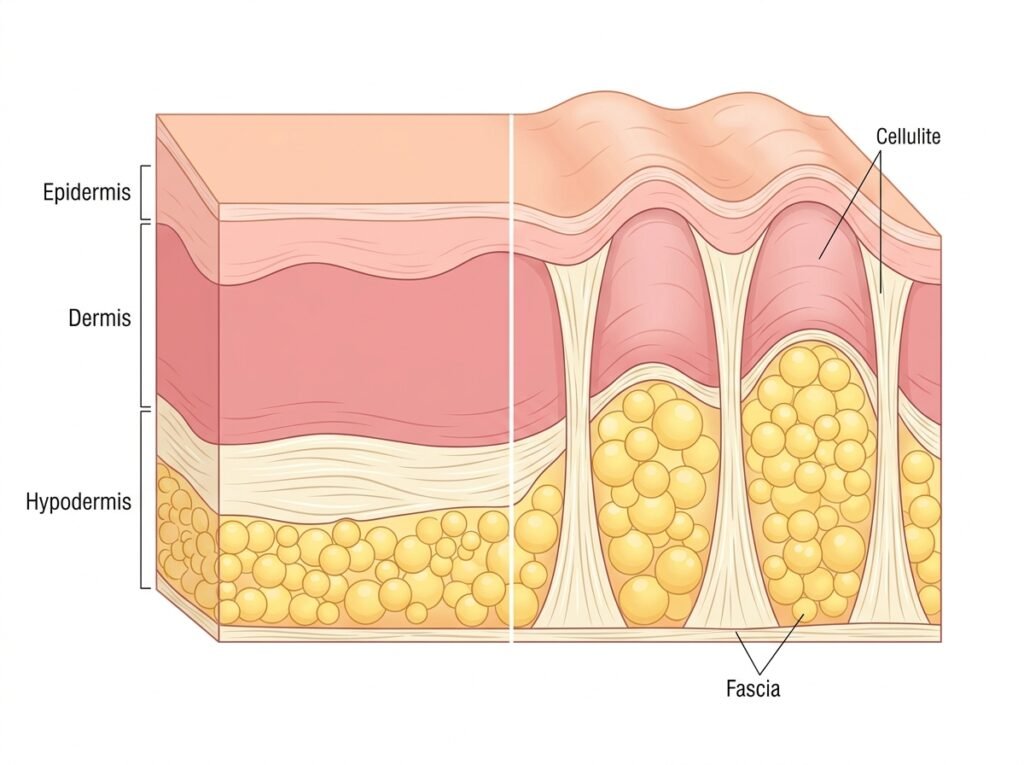
The visible dimpling associated with cellulite is a surface symptom of a deeper structural condition. The anatomical basis of cellulite involves vertical fibrous connective tissue septa in the subcutaneous layer, which create chambers of fat in the hypodermis (the deepest layer of skin, sitting below the epidermis and dermis). When those fat lobules expand or when the fibrous septa stiffen and contract, the fat pushes upward against the skin while the septa pull downward. The result is the characteristic dimpled, uneven texture.
This architecture sits between 5 and 15 millimeters below the skin surface, in the hypodermal layer. Cellulite affects 85 to 98 percent of post-pubertal females regardless of body weight, because it is driven by the structural orientation of connective tissue rather than by the amount of fat present. Lean women develop cellulite. Athletes develop cellulite. The condition is architectural, not cosmetic.
This distinction matters because the location of the problem determines what treatments can physically reach it.
The physics of skin penetration
The skin’s outermost layer, the stratum corneum, functions as a barrier. Its primary biological purpose is to keep foreign substances out. This is effective protection against infection and environmental toxins, but it also limits how deeply any topical product can penetrate.
The 500 Dalton rule, established by Bos and Meinardi in 2000, provides the clearest physical constraint: molecules with a molecular weight above 500 Daltons (Da, a unit measuring molecular mass) cannot cross the intact stratum corneum in clinically meaningful concentrations. Most active ingredients in anti-cellulite creams sit near or below this threshold, which means they can enter the epidermis and possibly the upper dermis. But the upper dermis is 1 to 2 millimeters deep. The hypodermal tissue where cellulite structures exist is 5 to 15 millimeters deep.
Even for molecules small enough to cross the stratum corneum, the concentration reaching deeper tissue drops sharply with every additional millimeter of depth. A molecule that enters the skin at a therapeutically useful concentration on the surface may arrive at the hypodermis at a fraction of that concentration, too diluted to produce a structural effect.
This is not a failure of formulation or product design. It is a physical limitation built into human skin biology.
What popular cellulite cream ingredients can and cannot do
Caffeine
Caffeine (molecular weight: 194 Da) is the most common active ingredient in cellulite cream formulations. It is small enough to cross the stratum corneum, and it has documented lipolytic properties (the ability to break down fat) in laboratory conditions. These two facts form the basis of most caffeine-based cellulite cream marketing.
The problem is one of depth and concentration. Caffeine applied to the skin surface can reach the upper dermis, approximately 1 to 2 millimeters down. The subcutaneous fat compartments responsible for cellulite dimpling sit 5 to 15 millimeters below. Even with absorption-enhancing formulations, the concentration of caffeine reaching the hypodermal layer is insufficient to trigger meaningful lipolysis in the fat lobules that are pressing against the fibrous septa.
Caffeine-based creams can temporarily tighten the skin surface through mild dehydration of the upper tissue layers, which is why some users report short-term smoothing effects. These effects reverse within hours because they address the surface texture, not the underlying architecture.
Retinol
Retinol (molecular weight: 286 Da) can cross the stratum corneum and has well-established effects on the upper dermis: it stimulates collagen production, improves skin texture, and increases epidermal thickness. A randomized, placebo-controlled trial of topical retinol for cellulite found that retinol modestly improved upper dermal elasticity and tension over six months but had minimal impact on the deeper structural dimpling caused by fibrous septa in the hypodermis.
This outcome is consistent with the physics. Retinol works at the depth it can reach (the upper dermis) and produces real effects at that depth (improved collagen density and skin texture). But it cannot address the stiff collagen bands and fat herniation happening 10+ millimeters below, because it never arrives there in meaningful concentrations.
Aminophylline and other common ingredients
Aminophylline (a theophylline derivative) appears in several clinical-strength cellulite cream products. Like caffeine, it has demonstrated lipolytic effects in laboratory cell cultures. Like caffeine, it is subject to the same penetration constraints: laboratory-demonstrated fat-burning activity does not translate to clinical cellulite reduction when the ingredient cannot reach the tissue where the fat is structurally trapped.
Peptides, botanical extracts, and various “firming complexes” face the same physical ceiling. Many of these molecules exceed the 500 Da threshold entirely, meaning they cannot meaningfully cross the stratum corneum at all. They may hydrate and temporarily plump the outer skin layers, but they do not interact with the subcutaneous structures that produce cellulite dimpling.
The energy threshold that topicals cannot reach
If topical molecules lack the physical capacity to reach the hypodermis, what does reach it?
Thermal energy. Specifically, radiofrequency energy that heats tissue to the 40 to 45 degree Celsius range triggers neocollagenesis and collagen remodeling in the dermis, according to histological studies by Zelickson et al. When collagen fibers in the fibrous septa are heated to this threshold, they soften, contract, and initiate a remodeling process. Over repeated treatments, the stiff bands that pull the skin surface into dimples become more pliable, and the visible texture smooths.
Radiofrequency (RF) energy is not limited by the 500 Dalton rule because it is not a molecule. It is electromagnetic energy that passes through tissue based on impedance, not molecular weight. RF energy generated at the skin surface can deposit heat at depths of 5 to 15 millimeters, directly into the hypodermal tissue where cellulite structures exist.
Mechanical massage adds a second physical intervention. While thermal energy remodels the collagen bands, mechanical tissue manipulation improves lymphatic drainage and physically kneads the tissue to redistribute fluid retention. Lymphatic congestion contributes to the visual severity of cellulite, and mechanical pressure addresses this component in a way that neither creams nor thermal energy alone can replicate.
The combination of RF thermal delivery and mechanical manipulation represents the physics-based approach to cellulite: reaching the correct tissue depth with enough energy to trigger structural change, while simultaneously addressing the fluid retention that amplifies the visible dimpling.
What this means for at-home anti-cellulite devices
For women evaluating at-home cellulite treatment options, the physics framework above narrows the field considerably. The relevant questions are: Does the device deliver energy to hypodermal depth (5 to 15 mm)? Can it sustain the 40 to 45°C threshold needed for collagen remodeling? Does it address both the fibrous septa and the lymphatic/fluid component?
Several at-home devices approach the problem from different angles, each with trade-offs in depth, modality, and price.
Budget multi-modality devices
If the budget is under $200, devices like the Project E Beauty SERA combine LED light therapy with low-intensity stimulation. This category is a solid entry-level choice for improving superficial skin texture and circulation. Because these devices rely on surface-level modalities rather than high-wattage radiofrequency, they struggle to reach the 42°C threshold in the deep hypodermal layers needed to release tight fibrous septa. For surface glow and mild texture improvement, they deliver value. For structural dimpling, the physics limits their reach.
Microcurrent-based toning
Microcurrent devices like the NuFace NuBody focus on electrical muscle stimulation (EMS) to tone the upper skin layers. The mechanism is similar to a targeted muscle workout beneath the skin surface: it produces temporary surface firmness by stimulating the muscles underlying the treatment area. But microcurrent is not thermal energy. It will not heat subcutaneous tissue to remodel collagen structure, which makes it less effective for the structural dimples created by stiff fibrous septa. For overall skin firmness and tone, microcurrent has a role. For deep cellulite architecture, the physics points elsewhere.
High-power clinical-grade RF
At the higher end, devices like the TriPollar Pose VX use strong RF technology adapted from clinical machines. The thermal delivery here is excellent: deep, sustained heating that meets the collagen remodeling threshold. The trade-off is a steep price point, often exceeding $490, and a design that relies heavily on manual movement without built-in dynamic mechanical massage. This means the RF component is strong, but the lymphatic drainage and mechanical tissue manipulation need to be performed separately or supplemented with manual technique.
Combined RF and mechanical massage
The Sensica Sensifirm addresses both sides of the cellulite equation simultaneously. It pairs clinical-grade Lipotherm RF™ with dynamic mechanical massage rollers, meaning the thermal energy softens the stiff collagen bands while the simultaneous massager kneads the tissue and helps release fluid retention. Automatic thermal sensors monitor skin temperature throughout treatment, preventing overheating while ensuring the energy reaches the effective range. For structural cellulite where both the fibrous septa and the lymphatic congestion contribute to visible dimpling, this combined approach aligns most closely with the physics-based requirements outlined above.
The bottom line on topical cellulite creams
Cellulite cream products are not worthless as skincare. Many contain ingredients that hydrate the skin, temporarily tighten the surface, and improve overall skin texture. These are real effects, and for women whose primary concern is skin smoothness and surface appearance, a well-formulated cream can deliver visible short-term improvement.
What these products cannot do, according to the physics of skin penetration and the structural anatomy of cellulite, is reach and remodel the tissue responsible for dimpling. The fibrous septa and fat herniation that create cellulite sit in a tissue layer that topical molecules cannot access in therapeutic concentrations. Addressing that tissue requires energy that can penetrate to hypodermal depth and heat collagen to its remodeling threshold, accompanied by mechanical manipulation to address the lymphatic and fluid components.
Understanding this distinction is not about dismissing creams. It is about understanding what each tool in a cellulite treatment protocol can and cannot do, and making decisions based on tissue physics rather than packaging claims.